|
Australia is an island continent with a extensive tropical
coastline. Its western shores mark the southeastern margins of the
Indian Ocean while, to the east, it provides the southwestern boundary
of the Pacific Ocean. Between these two is a complex, poorly known,
northern coastline which close to southern Indonesia, separated by the
Timor Sea to the west and the Arafura Sea to the east.
After Indonesia, Australia has the
largest area of coral reefs of any nation, nearly 50,000 square
kilometers, or some seventeen percent of the world's total area of
reefs. Conditions for reef development vary considerably along the
coastline. In the far west the climate is dry and there is little
terrestrial runoff. Reef development is not continuous, though away from
loose coastal sediments there are important areas, including Australia's
best developed fringing reefs. The southward flowing Leeuwin Current is
also important on this coastline, bringing warm waters to relatively
high latitudes and enabling the development of some unique reef
communities. Further north there are several reefs on the outer edges of
the continental shelf. These include remnants of what may have been a
substantial barrier reef structure drowned as a result of rising sea
levels over geological time scales. The northern coastline is less
known, however this is an area of high terrestrial runoff, and the
waters are shallow and turbid, greatly restricting reef development. The
eastern boundary of the Arafura Sea is marked by a narrow constriction,
the Torres Strait. East of here, the world's largest coral reef complex
commences, extending out to the margins of the continental shelf and
continuing southwards as the Great Barrier Reef. The warm, southward
flowing East Australia Current also supports the development of high
latitude reefs along Australia's eastern shores to the south of
the Great Barrier Reef. Other reefs are found in Australia's offshore
waters. Most notable among these are the extensive reef structures of
the Coral Sea, east of the Great Barrier Reef.
Australia also
administers the Cocos
(Keeling Islands and Christmas Island in the Indian Ocean, both of which
have significant coral reefs.
Australia's original human population,
the Australian Aborigines, are thought to have inhabited the country
for more than 40,000 years. These people, and the Torres Strait
Islanders who occupy parts of the far northeast of the country, have
traditionally made considerable use of reef resources. It seems likely,
however, that their overall impacts remained minimal. Population
densities were low, and a large area of offshore reef remained
inaccessible to them.
The dominant human impacts on coral
reefs can now be related to fisheries and terrestrial runoff from
deforestation, overgrazing and certain agricultural practices. Compared
with most countries, however, these impacts remain few. Population
densities are low in all coral reef areas, while the location of many
reefs at some distance from shore further protects them from human
impacts.
Considerable resources have been put
into coral reef research in Australia, and, despite the vast area of
reefs in the country, there is a good deal of information describing
their distribution and biodiversity. Equally importantly, the great
majority of Australia's reefs fall within protected areas. The Great
Barrier Reef Marine Park is the largest protected reef in the world, and
is well managed with a detailed zoning plan, providing areas of strict
protection alongside much larger areas of multiple use.

The
reefs in the west of Australia encompass a variety of types in a very
broad range of oceanographic conditions. For the most part this is a
very dry coastline with very little terrestrial runoff. It is also, from
a human perspective, very sparsely populated, and poorly documented. One
critical oceanographic feature is the Leeuwin Current which flows south
from Indonesia, carrying warm waters to relatively high latitudes,
particularly along the continental shelf edge.
Along the mainland coast, reefs are
discontinuous but very well developed in places. In the north the
continental shelf is very wide and dominated by turbid waters with
strong currents. Reef development is little known off the Eighty Mile
Beach, through further west there are scattered reefs among the Dampier
Archipelago and the Monte Bello Islands. Here, as the continental shelf
narrows, there is a great range of oceanographic conditions associated
with the gradient between nearshore turbid waters and clear offshore
waters, mixed by the complex current regime.
Australia's longest continuous fringing
reef system is the Ningaloo Reef which follows some two hundred and
thirty kilometers of the coastline running southwards from North West
Cape. The reef flats are well developed, lying between 0.5 and 7
kilometers offshore. The reefs receive the full impact of oceanic waves,
so corals tend to be quite low and compact. Biodiversity is very high,
with some three hundred species of coral, nearly five hundred species of
fish and over six hundred mollusks. The area is also noted for the
appearance of whale sharks. These giant plankton-feeders occur in
considerable numbers between mid-March and mid-May.
The
marine areas of the Shark Bay World Heritage Site are of considerable
interest, including some of the most extensive seagrass communities in
the world and harboring what is probably the largest dugong population
in the world (over 10,000). Monkey Mia Bay has become famous for a tame
group of bottle nosed dolphins, but the region is also of considerable
importance for other cetaceans, including humpback and southern right
whales. Hamelin Pool, within the Shark Bay area, is one of the few
places in the world where there are actively growing stomatolites.
Hypersaline conditions prevent the
survival of most organisms, but photosynthetic bacteria and microalgae
survive and form microbial mats as they trap and bind sediments. Over
the last 4,000 years these mats have developed into relatively large
structures -columns or mounds up to 1.5 meters high.
The southernmost true reefs in the
Indian Ocean are around the Houtman Abrolhos Islands which lie close to
20 degrees South on the edge of the continental shelf. Lying on the edge
of the continental shelf they are directly affected by the Leeuwin
Current which moderates the winter temperatures, and may also have a
critical role in larval supply. Considering their high latitude, these
reefs have a significant diversity, with over one hundred and eighty
coral species and over two hundred and thirty fish.
Further south there is no true reef
development, though Rottnest Island off the coast near Perth is fringed
by shallow platforms where some twenty five species of zooxanthellate
corals have been recorded. The importance of the warming effect of the
Leeuwin Current is equally strong here. Low human populations generally
restrict impacts on the reefs off the west coast of Australia, although
there is some fishing in all areas. Around the Dampier and Monte Bello
islands there is increasing pearl oyster farming, petroleum exploitation
and now some tourism, although these impacts are not very high. Two
large protected areas have been declared which provide at least some
protection for the reefs in Ningaloo and Shark Bay.
Cocos (Keeling) Islands and
Christmas Islands are two
territories administered by Australia with important oceanic
communities. Located far out in the Indian Ocean, Cocos (Keeling)
consists of two atolls on the Cocos Rise, nearly mid-way between
Australia and Sri Lanka. They are dominated by the southeast trade winds
and swept by the westward flowing equatorial current most of the year,
and are occasionally impacted by tropical cyclones. These islands were
in fact the only atolls where Charles Darwin ever landed during his
voyage on the Beagle in 1836.
Christmas Island is a high, mountainous
island some fifteen kilometers across, reaching a height of three
hundred and fifty nine meters. Fringing reefs surround much of it, and
while the reef faunas clearly contain Indian Ocean elements they show a
close affinity to Southeast Asia. Diversity is somewhat limited by
a moderate range of reef habitats. The island has important seabird
nesting colonies, including the endemic Christmas Island frigate bird.
Large numbers of crabs are also noted, including thirteen land crabs,
the best known of which are red crabs Gecarcoidea natalis, which
have a population of some 120,000,000 individuals and undertake an
annual mass migration to spawn in the sea. Over sixty percent of the
island and much of the fringing reef is protected in a national park.

OFFICIAL, SCIENTIFIC &
GOVERNMENTAL SITES:
Reef Base: Australia
COMMERCIAL:
Ningaloo Reef Tourism Western Australia

North of Port Headland and Eighty Mile
Beach the continental shelf of Australia widens considerably while the
coastline of Indonesia and East Timor forms a northern boundary
enclosing the Timor Sea. To the east of Darwin this continental shelf
widens further still and connects Australia to New Guinea across the
Arafura Sea and the Gulf of Carpentaria. This is Australia's least known
and least populated coastline. Wide areas are dominated by an intricate
network of rivers and channels with extensive mangrove communities.
To the east, in the Arafura Sea, the waters are shallow and turbid and
there is little reef development. Fringing reefs are reported further
west, but are very poorly described. The only reefs in this region which
have received attention are those lying in the northwest on the
continental shelf edge or just beyond.
The Rowley Shoals, Scott Reef and
Seringapatam Reef are shelf edge atolls lying on the continental slope
in clear oceanic waters. An extensive live of other reefs, including
Lynher, Cartier, Ashmore and Hibernia, lies just on the continental
shelf, and it has been suggested that these may in fact be barrier
structures. A number of deeper shoals on the shelf edge indicated
that there may have been a more extensive barrier reef along this shelf
during recent periods of lower sea level, but that only these structures
kept up with rising sea levels. Tidal ranges are very high around these
reefs and there is considerable wave energy, so the reef crests are
dominated by coralline algae, while only compact coral formations have
developed on windward shores. This is an area regularly affected by
cyclones.
Coral
cover is typically high. Ashmore Reef has the greatest biodiversity in
the region: some 255 species of hermatypic corals have been recorded,
747 fish, 433 mollusks and 192 echinoderms. This region also probably
has a greater diversity of sea snakes than anywhere else in the world,
with twelve species recorded at Ashmore Reef. Seabird nesting
colonies are also extremely important and seventeen species (with
an estimated 50,000 pairs) have been recorded nesting on the
islands of Ashmore.
The more northerly reefs lie relatively
close to Indonesia and are regularly fished by Indonesians under a joint
agreement. Elsewhere, including near Scott Reef, there is some
extraction of natural gas, and further exploratory drilling and the
establishment of new oil and gas platforms could bring further human
impacts to these otherwise remote reefs. Ashmore Reef and the Rowley
Shoals all have some degree of legal protection, and there is ongoing
monitoring of Scott Reef and the Rowley Shoals.
OFFICIAL, SCIENTIFIC &
GOVERNMENTAL SITES:
Reef Base: Australia

The
largest coral reef system in the world runs along the northeastern
coastline of Australia, stretching from the Warrior Reefs in the
northern Torres Strait for well over 2,000 kilometers to the
Capricorn-Bunker group of reefs and islands in the south. Although many
of the reefs which make up this system form part of a true barrier reef
following the continental shelf on its outermost edge, the Great Barrier
Reef is actually a highly complex system including nearly 3,000 separate
reefs and coral shoals, as well as high islands with fringing reef
systems.
The origins of the Great Barrier Reef
can be largely traced back some 2 million years, when continental drift
brought the northern coastline of Australia into tropical latitudes and
some minor reef development began. Widespread development is thought to
be much more recent however, and can be largely traced back within
500,000 years, making it a much younger structure than many oceanic
atolls. As with coral reefs the world over, periods of reef building
were continually interrupted by changes in climate and shifting sea
levels. Typically reef accretion was confined to relatively short
periods of higher sea level when reef structures began to build up on
the margins of continental shelf. As sea levels fell, the reefs died,
became land and were subject to erosion forces which in many places
reduced their size again. High sea levels returned and allowed new reef
growth, typically most prolific on the remaining structures of the
earlier reefs. At the present time in geological history, sea levels are
particularly high, such that the base of many of the present reef lies
in depths unsuitable for active reef growth. However, active reef
building continues on the ancient structures and the reef continues to
thrive. The most recent period of growth is probably about 8,000 years.
Although
best seen as a continuous reef complex, it is possible to distinguish a
number of ecological regions within the Great Barrier Reef. These are
the Torres Strait area, Northern Section, Central Section, The Swain and
Pompey Complexes and The Capricorn-Bunker Group.
Torres Strait located in the far north of Australia
receives considerable freshwater and sediment input from the Papua New
Guinea coastline, however there are several very extensive platform
reefs across the relatively shallow waters of the Strait. The
westernmost areas have the shallowest and most turbid waters. A
large chain of reefs runs between Prince of Wales Island and Moa Island.
Like other reefs in the area, these show a very clear east-west
alignment associated with the high velocity tidal currents running
through the area. The Warrior Reefs further to the north and east run in
a chain towards the coastal town of Daru in Papua New Guinea. Sediment
loads are high in this area, and much of the shallow surface of these
reefs is dominated by soft muds, although they are fringed by coral on
their eastern margins. Finally there is a wide area of platform reefs
around Darnley Island, stretching out towards the edge of the
continental shelf and the near continuous reefs which mark the northern
edge of the outer barrier reef.
The Northern Section of the Great Barrier Reef has as its most
distinctive feature the well developed ribbon reefs typically less than
500 meters wide but extending up to 25 kilometers in length and
separated by relatively narrow passes. They are located on right on the
edge of the continental shelf, and depths drop rapidly to over 1,000
meters only a few hundred meters from the eastern edges of some
reefs. For about 80 kilometers, in the northernmost sector of these
ribbon reefs, there are spectacular deltaic formations in the channels
between the reefs, formed by the powerful currents which flow between
the reefs.
Inshore of the ribbon reefs there are
well developed mid-shelf and inner shelf reefs, while there are also
wide areas of submerged Halimeda-dominated shoals and banks. This
is one of the only areas where there are fringing reefs directly
adjacent to the mainland coast, although coral cover and diversity are
limited. Raine Island just off the continental shelf has the largest
nesting populations of green turtles in the world as well as some of the
most important seabird rookeries.
The Central Section extends from Mossman in the north to the
barrier reef offshore from the Whitsunday and Lindeman Islands. Over
this area the continental shelf gradually widens, with reef development
largely restricted to its outer third. Closer to the mainland the waters
are subject to considerable fluctuations in turbidity and salinity due
to the seasonal flooding of rivers. The reefs in this region are younger
than those to the north. Many have lower and less extensive reef flats,
and coral cays are largely absent, while their outer reef crests are
often only clearly developed on the windward southeastern margins.
Overall the reefs are less tightly packed and hence do not form such a
continuous barrier. In addition to the barrier reef structures there are
important fringing reef communities associated with a number of high
island groups, notably the Palm Islands and the Whitsunday and Lindeman
Islands to the south.
The Swain and Pompey Complexes
are in a sector of the Great Barrier
Reef where the continental shelf is at its widest and the main reefs are
furthest from shore. The Pompey Complex has a number of submerged reefs
on the edge of the continental shelf. However, about ten kilometers back
from this edge is a vast and complex array of very large reef
platforms separated by countless meandering channels making a nearly
solid mass of reefs nearly 200 kilometers in length and up to twenty
kilometers wide. To the south the Swain Reefs form a second distinctive
complex, dominated by many much smaller and even more closely spaced
reefs where large numbers of small coral cays have developed. Inshore of
the main Swain and Pompey Complexes reef development is limited, however
there are some reefs close to the mainland and associated with island
groups such as the Northumberland Islands and Percy Isles.
The Capricorn-Bunker Group
lie south of the Swain Reef Complex
and are a relatively small complex, well defined with steeply sloping
reef edges and deep inter-reefal waters. There are several well
developed coral cays, included One Tree Island and Heron Island, which
are among the best known reefs of the Great Barrier Reef.
Levels of biodiversity are generally
very high in the Great Barrier Reef, with some 350 coral species,
1,500-2,000 species of fish, and over 4,000 species of mollusks. As
might be expected with any reef system traversing such a wide
latitudinal range, there is a gradual diminution of species diversity
towards higher latitudes. Even more notable are cross-shelf differences.
Close to the mainland there are high levels of nutrient inputs,
sediments and freshwater, while offshore such inputs diminish and
conditions on the outer reefs can be considered near oceanic, with low
levels of nutrients and clear waters. These differences have led to
considerable variation in the species assemblages depending on their
location on the continental shelf.
One of the most spectacular phenomena in
nature was first observed on the Great Barrier Reef - the mass spawning
of many corals which takes place every year for a few nights after a
particular full moon in the late Australian spring -typically November.
At this time, the majority of scleractinian coral species, together with
many other reef organisms including sponges, holothurians, polychaetes
and giant clams, undergo a mass spawning event. This is highly
synchronized, with individuals of the same species releasing eggs
and sperm often minutes of one another over wide areas of the reef. This
phenomena was first observed in November 1982, and yet is one of the
most spectacular events on any coral reef.
In addition to its considerable
diversity in terms of coral reef organisms, the Great Barrier Reef is
also an extremely important region for other marine and coastal
ecosystems, most notably seagrass and mangrove communities. Mangroves
generally lie a considerable distance from coral reef communities -with
the exception of a few fringing reef systems. But some 37 mangrove
species from 19 families have been recorded at the Great Barrier Reef,
with the highest levels of diversity in the "wet tropics" north of
Cairns. Seagrass communities are also widespread, with some 3,000 square
kilometers of mapped seagrass shallows, and an estimate of at least
2,000 square kilometers of deep seagrasses. Both seagrass and mangroves
are extensively used as breeding and nursery grounds by many species,
including a number of commercially important species, and some reef
species. Seagrass beds are also important for some turtle species as
well as large populations of dugongs. Green, hawksbill, loggerhead and
flatback turtles all nest in considerable numbers in the region. In
addition some twenty-six species of cetacean are resident and visitors
to the Great Barrier Reef, including significant numbers of humpback
whales which breed in the southern and central waters. There are also
important seabird communities on the Great Barrier Reef, with over 55
major nesting islands and some 1.4 to 1.7 million breeding birds from
twenty-three species, with a further thirty-two non-breeding species.
The Great Barrier Reef has been one of
the regions most extensively impacted by the crown-of-thorns starfish,
with the first mass outbreak of this predator observed on Green Island,
off Cairns, in 1962. While there is much to learn about these outbreaks,
it is clear they have had a significant impact on the ecology of the
region, causing apparently periodic massive losses of live coral cover.
In general, the Great Barrier Reef
is not heavily affected by human activities, but there are some concerns
that deforestation, poor agricultural practices and high concentrations
of agricultural chemicals and nutrients in terrestrial runoff may have
some impacts, particularly on those reefs closest to the mainland. The
majority of reefs, however, are far offshore and this, combined with the
prevailing long-shore currents, reduces the effects of land based
sediments and pollutants. The distance from the mainland of most reefs
also makes access more difficult, while the coastal population adjacent
to the reef is small overall and does not generally exert a very large
direct impact on the reefs, except for some commercial fisheries.
Utilization of marine resources by the
wider population if far more significant than that by indigenous
communities, including the Aboriginal inhabitants of Australia.
Recreational fishing is extremely popular, although it typically targets
the reefs closest to the mainland and near the major population centers.
The
vast majority of the Great Barrier Reef receives protection as the Great
Barrier Reef Marine Park, the world's second largest protected area.
This covers most of the lagoon and all of the offshore reefs from the
Capricorn-Bunker group to the northern tip of Cape York Peninsula. A
large proportion of the remaining coastal waters and terrestrial areas
of the offshore islands which are not covered by the park fall within
other protected areas. The park itself is zoned. About 80 percent of its
total area is open for general use including commercial fishing and
trawling (with permits). Only about five percent is closed to fishing
activities, but this includes over 120 reefs (about twelve percent of
the total). The park is managed by a specially designated federal
agency, the Great Barrier Marine Park Authority, in collaboration with
the Queensland Department of Environmental and Heritage.
OFFICIAL, SCIENTIFIC &
GOVERNMENTAL SITES:
Australian Coral Reef Society
Australian Government Department of Environment
and Heritage: Great Barrier Reef
Australian Government Great Barrier Reef Marine
Park Authority
Australian Marine Sciences Association
Dugongs: Australian
Great Barrier Reef
National Geographic website on the Great Barrier
Reef
Reef Base: Australia
COMMERCIAL:
Great
Barrier Reef Visitors Bureau
Macgillivray Freeman's Coral Reef Adventure:
Great Barrier Reef
Outback Reef Adventures
Scuba
Dive on the Great Barrier Reef
Underwater Photography of Great Barrier Reef

Due east of the Great Barrier Reef and the
Torres Strait, Australia holds jurisdiction of a large number of reef
formations lying some distance off the continental shelf. The majority
of these are located in an area known as the Coral Sea. Most are atoll
formations, stretching from Osprey Reef in the north to Saumarez Reef in
the south. In general they have relatively low coral cover, and
both coralline algae and sponges make up a considerable proportion of
the substrate. Total algae cover is often greater than coral cover.
There are important bird nesting colonies on some of the coral cays,
while the beaches are widely utilized by nesting turtles.
OFFICIAL, SCIENTIFIC &
GOVERNMENTAL SITES:
Reef Base: Australia

South of the Great Barrier Reef there are
several reefs and coral communities at high latitudes. The south flowing
East Australia Current has an important role to play in maintaining
these communities, bringing warm waters ass well as the potential for
new larval recruits to settle on the reefs. Biodiversity is low in these
areas but they remain of significance since they represent the
ecological limits of many species.
OFFICIAL, SCIENTIFIC &
GOVERNMENTAL SITES:
Reef Base: Australia

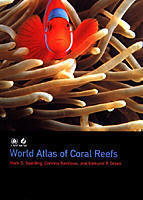
Extracted and adapted from The World
Atlas of Coral Reefs, by Mark D. Spalding, Corinna Ravilious and Edmund
P. Green, published by the
University of California Press .
For more complete and in-depth coverage of the topics presented in this
webpage, I recommend highly purchasing a copy of this beautifully
illustrated book. Just click on the University of California Press link
above to do so.
|