|
The northern island areas of the Central and Western Pacific are characterized
by widely scattered archipelagos of relatively small islands. Reefs are well
developed throughout the region, except on the coastlines of recently active
volcanoes. Palau lies closest to the center of reef diversity in the Philippines
and Indonesia, and shows very high levels of species diversity. Biodiversity
declines to the east.At the present time
there is considerable differences both in the state of the reefs and the
impacts of human cultures. The influence of the USA, associated with
rapid Western-style development, is considerable in a number of
countries, notably Guam, but also in parts of the Marshall Islands.
Urban growth on a few islands has brought with it the breakdown of
traditional systems and the sustainable utilization of resources,
together with associated problems of pollution. Military activities have
also had a considerable impact in the region. Intensive nuclear testing
during the 1940's and 1950's impacted a number of tolls in the Marshall
Islands, with repercussions to the present. There is also ongoing
utilization by the USA of some islands and reefs in the Marshall Islands
and the Marianas for military purposes, including target practice.
Tourism is a critical and growing economic activity in a few islands,
notably Guam, Saipan and Chuuk Atoll. Away from areas of human impact,
the region still includes a very large number of islands and reefs in
good to excellent condition, where the traditional use of the reefs by
local peoples remains sustainable and well managed.

The Mariana Islands forma a long chain of
15 high islands in the Western Pacific, running approximately 800
kilometers from Faraloon de Pajaros (Uracas) in the north to Guam in the
south. The southernmost island of Guam is an unincorporated territory of
the USA, while the remaining islands, the Commonwealth of the Northern
Mariana Islands, are a commonwealth in political union with the USA.
Guam is the southernmost and largest of the islands, and is entirely
circled by fringing reefs.
The Mariana Islands,
lying relatively close to the center of coral reef biodiversity in the
Philippines and Indonesia, enjoy high diversity. Guam, which is fairly
well studied, has about 300 recorded species of scleractinian corals,
950 species of reef fish, 220 species of benthic algae and more than
1,400 species of mollusks. Both diversity and cover decrease
considerably in the geologically younger northern islands where the
geological conditions are unfavorable for many species, while in the far
north cooler conditions may further restrict certain species.
Natural pressures on the
reefs around Guam have been greatly exacerbated in recent years by human
activity. Agriculture, development and the burning of natural areas have
led to increased sedimentation in the surrounding waters, while over
fishing is widespread and total catch per unit of effort reportedly feel
by 78 percent between 1985 and 1997. The overall impact on the reefs has
been considerable. Coral cover is reported to have dropped
significantly since the 1970's, when it was over 50 percent in many
areas.
Human pressures are
largely focused around the urban areas of the barrier reef system in
western Saipan, but also at Rota West Harbor and San Jose Harbor on
Tinian where there are problems of pollution and sedimentation.
Overfishing is believed to be occurring on Saipan and Tinian, where
fisheries data show low average sizes of many reef species. Finally the
island of Farallon de Medinilla has been extensively used for target
practice by the U.S. military. Local objections have been raised,
with campaigns to have this activity restricted or moved to one of the
more active volcanoes where the impacts may be less detectable. Thus far
no serious efforts to relocate have been made.
The economy of both
territories is highly dependent on tourism. Guam receives more than 1.4
million visitors per year, while the CNMI receives about 500,000,
primarily limited to the island of Saipan. Diving and snorkeling are
popular tourist activities. Research on the reefs is well advanced,
particularly in Guam where there is an active marine laboratory
associated with the University of Guam. Several protected areas have
been established, included a number of coastal and marine sites in Guam
and some in the CNMI.

OFFICIAL, SCIENTIFIC &
GOVERNMENTAL SITES:
Commonweath of
the Northern Mariana Islands Coastal Resources Management
Commonwealth of
the Northern Mariana Islands Division of Environmental Quality Website.
JaneResture.com Guam
COMMERCIAl:
Welcome
to Guam

Palau makes up the western end of the
Carolina Islands. It is dominated by a large complex of islands and
reefs, consisting of the Kayangel Islands in the north; the large island
of Babeldaob (Babelthuap) in the center; and the Rock Islands
(Chelbacheb Islands) to the south. Coral reefs are widespread. Most of
the northern islands are concentrated on a single shelf fringed by a
well developed barrier reef of some 290 kilometers in length. In the
southern parts of the lagoon there is a considerable number of fringing
and platform reefs. North of this large platform, Kayangel and
Ngaruangel are both atolls. To the southeast of this main group of
islands there are several widely scattered ones. These are mostly
platform islands (Fana, Sonsoral, Pulo Anna and Tobi), although Merir
and Helen Reef are atolls with a single island on each. Helen Reef has a
partially submerged rim.
The climate in Palau is
warm and generally humid. From November to June the northeasterly trade
winds dominate, but for much of the rest of the year winds are lighter
and more variable, although occasional typhoons also occur around this
time.
Levels of biodiversity
are very high. Some 425 species of coral have been reported , including
an estimated 300-350 stony corals, together 1,278 species of reef fish
and well over 300 species of sponge. The southern reefs are swept by
strong currents and dominated by blue coral Heliopora coerulea,
however they are also very diverse. Helen Reef was recorded as having
248 stony coral species, perhaps the highest number for any Pacific
atoll. Coral cover in all areas was high prior to 1998, typically over
50 percent and reaching 70-80 percent on outer reef slopes in many
areas. Marine turtles are relatively common and the estuarine crocodile
Crocodylus porosus and dugong Dugong dugon are found in
the lagoon. There are important areas of mangrove and seagrass communities. One interesting and perhaps unique ecosystem in this
country is found in the large number of marine lakes.. These are inland
but appear to be connected to the ocean by cave systems and have
developed highly distinctive communities which appear to have evolved
in situ from species that entered the lakes in larval forms. The
most distinctive of such organisms are the jellyfish, notably
Mastigias spp. which have formed vast communities. Marine lakes are
most common on Koror where there are 58, of which 28 have jellyfish. The
Reefs of Palau were heavily impacted by crown-of-thorns starfish
outbreaks in 1977 and recovery was reported to be poor, even into
the 1990's. The reefs were further impacted by the bleaching event of
1998,with mortality reaching over 50 percent in most areas. Acopora
was devastated almost everywhere, but other corals showed slightly
higher levels of survival in nearshore lagoons and fringing reefs. The
warm waters of 1998 also had a dramatic impact on jellyfish populations
in some of the marine lakes, although they now appear to be recovering.
The crown-of thorns starfish has had a number of outbreaks, and high
densities in some areas may be exacerbating the setbacks caused by
bleaching-associated mortalities.
The majority of the
Palauan population live on Koror, but numbers are growing rapidly and
there is some expansion to the other islands. Management of marine
resources is devolved to the state level. The individual states (of
which there are 16, each typically incorporating several villages) have
ownership of all living and non-living resources out to 12
nautical miles, with the exception of highly migratory species. Although
traditional law is upheld in the constitution it has been combined with
Western statutes, and respect for traditional systems is diminishing.
Several of the islands are connected by bridges and causeways which have
interfered with natural water circulation in some areas. Sewage and
solid waste disposal are a localized problem.
Fishing is at the
subsistence level is very important, but there are also some export
fisheries, including a trochus fishery and a large marine ornamental
fishery. There is considerable evidence of overfishing of certain target
species, notably groupers, and a number of these are showing declines in
abundance and changes in demographic structure. In the southwestern
islands there have been reports of blast and cyanide fishing.
There is an active
interest in conservation in the country. Protected area legislation is
developed at the state level, but a number of sites have been
established with regulations ranging from seasonal closures and other
fisheries restrictions to strict reserves with no entry permitted. For
the most part there is strong community support for these areas. The
Ngaremeduu Conservation Area has also been recently established covering
parts of three states on the west coast of Babeldaob. Legislation has
had to be passed in each state to protect this site. Additionally, the
American-based organization, Center for Ecosystem Survival, has an
innovative "Adopt A Reef" program for sponsorship to help protect
Palau's coral reefs.
The Federated
States of Micronesia consists of a
vast and scattered chain of islands stretching some 2,900 kilometers
from east to west. Politically they are independent, but remain in a
"compact of free association" with the USA. Although the total area is
small, there are some 600 islands with diverse geological origins. The
total reef area is very large indeed, over 5,000 square kilometers, but
remains very poorly known.
Biodiversity is slightly
lower than in Palau, with decreasing diversity moving from west to east.
Reef status throughout the country is through to be good. Mangrove
communities are particularly well developed around the coastlines around
the islands of Pohnpei and Yap. The reefs are of critical importance as
a source of food throughout the country. Close to urban areas there is
some overfishing and there have been problems with blast fishing. Clams,
in particular giant clams, are declining and have been completely
eliminated in some areas. Coastal development and associated pollution
are again localized problems on the largest islands, but for the most
part the reefs remain in good condition. Many reefs are owned and
managed at the level of the individual villages. There are no permanent
protected areas other than a few small trochus sanctuaries.
Tourism is growing with
considerable speed in a few islands, although the more remote islands
remain largely unvisited. Chuuk Lagoon is widely regarded as one of the
world's top dive centers on account of the very large number of wrecks
which sunk in the lagoon during World War II. About 50 Japanese
ships, plus numerous Japanese and American aircraft went down during a
two-day American attack in February 1944.
OFFICIAL, SCIENTIFIC &
GOVERNMENTAL SITES:
Center For Ecosystem Survival: Adopt A Reef Palau
NOAA Center For Coastal Monitoring and
Assessement: Coral Reef Report -Palau
PBS Readers Digest Edens: Palau

The Marshall Islands are a complex of 28
coral atolls and 5 small (non-atoll) islands lying in two broad chains,
the eastern Ratak (sunrise) chain and the western Ralik (sunset) chain.
In all there are some 1,136 islands dispersed over a vast area of ocean,
although the land area is very small. The atolls are typically circular
to elliptical with shallow lagoons. Kawajalein, at some 2,500 square
kilometers, is the largest atoll in the Pacific.
The location of the
Marshall Islands places them in an area of fairly high diversity, while
the relative lack of pressure on many of the reefs means that there has
been little biodiversity loss. Nearly 250 coral species have been
recorded at Bikini Atoll, and over 250 species of reef fish are noted.
There are important seabird populations, particularly in the northern
atolls, with at least 15 breeding species among the 31 recorded in the
islands. Some 27 species of whale and dolphin have also been recorded.
The Marshall Islands
form a politically independent state, but exist in a "free association"
with the USA. Two thirds of the population live on Majuro and Ebeye
where they are concentrated into a relatively small area. Consequently
there are various environmental problems, including sewage and solid
waste pollution. Much development has taken place with little concern
for the environment, and the mining of lagoon sand to obtain building
materials is widespread.
Perhaps the best known
"use" of the atolls of the Marshall Islands was nuclear testing by the
USA in the 1940's and 1950's, when some 67 nuclear detonations were
performed on Bikini and Enewetak atolls. A study carried out in 1994
confirmed that some 15 atolls and islands were subject to some
radioactive fallout during the 1950's, although most of them are now
considered clear. The detailed impact of these tests on the coral reef
environment are still unknown, although there were obviously
important significant physical affects in the areas of direct impact,
while a number of large ships were also sunk in the atoll lagoons.
Although there is a
considerable amount of environmental legislation, enforcement is
limited. Two protected areas (Bikar and Bokaak Atolls) were established
prior to independence but have not been re-established and hence are not
recognized officially.
OFFICIAL, SCIENTIFIC &
GOVERNMENTAL SITES:
NOAA Center For Coastal Monitoring and
Assessement: Coral Reef Report -Marshall Islands

Kiribati's
islands and coral reefs straddle a vast swathe of the Pacific Ocean but
consist of only some 33 islands or island systems. These are typically
divided into three broad groups. Most of the actual islands are now
referred to by their Micronesian names, although the island groups are
still largely referred to by their European names.
The atolls comprise a
typical diversity of habitats, including channels, lagoon reefs and
shallow reef flats as well as reef slope environments. There is a clear
difference between windward and leeward sides, with the windward
(eastern) sides typically having a continuous reef margin, narrow reef
flat and well developed islands. The leeward reefs are typically much
wider, but in some places show a more gradual slope with a less
developed reef flat, often submerged at low tide. Spur and groove
formations are on all sides, but are usually best developed on lee
shores.
Given the wide
geographic spread of this country it is possible to follow some of the
wider regional trends within the country itself, notably the diminishing
species diversity moving from west to east. Some 115 hard coral species
have been recorded from Tarawa and Abaiang Atolls in the west, while
Tabuaeran in the east has 71. Blue coral Heliopora coerulea
is reported to
be widespread in the west despite being uncommon over
nearby areas in the Pacific. Coral cover on the outer reef slopes is
typically very high, with measurements on Tarawa and Abaiang of up to 57
percent cover at 3 meters depth and 28-72 percent at 10 meters.
Much of the remainder of the benthos is dominated by coralline algae.
There are several very important seabird nesting colonies in the Phoenix
and Line Islands, with many millions of birds, including the Phoenix
petrel and the Polynesian storm-petrel.
The population of
Kiribati is low and almost entirely concentrated in the Gilbert Islands.
Elsewhere most of the islands are uninhabited, in many areas because
freshwater is not available. Most of the islanders are heavily dependent
on fish as a source of protein, and over fishing is a localized
problem near population centers. Reports of increasing incidence of
ciguatera poisoning have been linked to other environmental disturbances
including the dredging of channels and construction of causeways,
although these links remain unproven. Locally, notably in the Tarawa
lagoon, sewage pollution may be a problem.
Other threats to
Kiribati's reefs include causeway construction, possible introduction of
non-native species and phosphate mining. Perhaps the greatest threat is
that of sea-level change as a result of global warming. Despite this
list of threats, the majority of reefs in this coral reef nation are in
excellent condition. A number of protected areas have been established.
Although they do not incorporate significant marine elements, they do
ensure that wider ecosystems are not disturbed.
Nauru is a single island country lying in
considerable isolation to the west of Kiribati. Geologically it is a
raised coral atoll reaching a maximum height of 71 meters. Surrounding
the island is a continuous fringing reef with a reef flat up to 300
meters wide. The biodiversity of the reefs have not been extensively
surveyed but the coral fauna is considered to be highly diverse. No
seagrasses and only one species of mangrove have been recorded.
On land the entire
surface of Nauru has been transformed by phosphate mining, with much of
the island now unusable and the population concentrated close to the
coast. Although mining is the main source of income the closure of
mining operations is planned in the very near future. Fishing is
still an important activity, and there are reports of certain species
becoming rare as well as average size of some fishes diminishing.
One impact of the mining industry has been the loss of traditional
environmental knowledge. At the same time there are few formal legal
controls on reef utilization under the existing fisheries legislation,
and no protected areas.. Sewage pollution and solid waste are
significant problems.

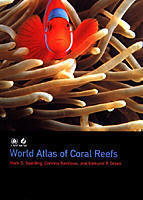
Extracted and adapted from The World
Atlas of Coral Reefs, by Mark D. Spalding, Corinna Ravilious and Edmund
P. Green, published by the
University of California Press .
For more complete and in-depth coverage of the topics presented in this
webpage, I recommend highly purchasing a copy of this beautifully
illustrated book. Just click on the University of California Press link
above to do so.
|