|
The
Pacific Ocean is a vast region and includes four distinct sub regions: Australia, Melanesia,
Micronesia and Polynesia, incorporating the eastern shores of
Australia and stretching towards the coastline of the Americas. There
are more coral reefs here than in any other part of the world: over
forty percent of the global total, including the most extensive areas of
barrier reefs and coral atolls. It was by looking at this region that
Darwin developed many of his ideas on the development of reefs.
Tropical storms or cyclones are a regular
disturbance in areas away from the equator, and become more numerous in
the western parts of the Pacific. The general westward flow of the
surface waters, which are heated as they flow, sets up a number of
gradients, including an important pressure gradient. Occasionally this
system undergoes reversal in a process known as El Nino Southern
Oscillation (an "El Nino event"). Such processes are typified by
warm water upwellings across the region and even around the globe. The
impacts of such events on coral reefs can be considerable, as witnessed
by the mass bleaching events of recent years.
In terms of biodiversity this is a very
important, although still little studied, region. In the far west it
encompasses the edges of the Indonesian-Philippine center of coral
diversity, and there is evidence to suggest that biodiversity on reefs
in Papua New Guinea may be at least as high as in these countries.
Moving east across the region there is a clear gradient of diminishing
diversity which appears to be reflected in all of the major groups of
coral organisms, as well as in mangroves and seagrasses. There are some
forty-five mangrove species recorded from Australia and Papua New
Guinea, but only three from Samoa, with none occuring east of Samoa.
Knowledge of reefs in this region is still extremely limited.
Australia's Great Barrier Reef has been extensively studied, but its
vast size means that, even here, many reefs are only occasionally
visited by scientists. French Polynesia is another relatively well
studied area, but it has been estimated that only about half of the reef
systems have been visited by scientists, and there is published material
on less than a quarter of them.
In the Reefs at Risk anaylsis this
region was assessed as being one of the least threatened in the world.
Population densities are generally low, and there are large areas of
coral reefs which are far from any human populations. Despite this,
human reliance on the coral reefs of the region is considerable. For
many of the small island nations they are a critical source of food, as
well as offering protection from storms. Many areas, and some entire
nations, are comprised solely of small cays, entirely the product of
reef development, and only a few meters above sea level at their highest
points.
Western-style
development is limited in many countries, and wide areas of reef still
fall under some form of customary marine tenure. Traditional systems for
controlling local fishing often include relatively complex and effective
management routines. Enviromental problems do occur in some areas. There
is evidence of target species over fishing in many countries, and
populations of clams and trochus have collapsed in several nations, even
before export fisheries for these species had begun. Modern fishing
methods have allowed access to more remote reefs, and more thorough
harvesting. As traditional systems break down, some areas have seen
considerable overexploitation, and also destructive fishing. These
problems do not affect wide areas, but are important, particularly
because they are focussed close to high population densities and they
are clearly diminishing the potential of the reefs as a renewable source
of food.
Pollution and
sedimentation are generally not widespread, but are clearly a concern in
localized areas, especially where there is urban development. On the
high islands sediment runoff and pollution from agriculture and mining
can be a problem.
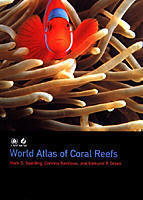
Extracted from The World Atlas of
Coral Reefs, by Mark D. Spalding, Corinna Ravilious and Edmund P. Green,
published by the
University of California Press .
For more complete and in-depth coverage of the topics presented in this
webpage, I recommend highly purchasing a copy of this beautifully
illustrated book. Just click on the University of California Press link
above to do so.
|